
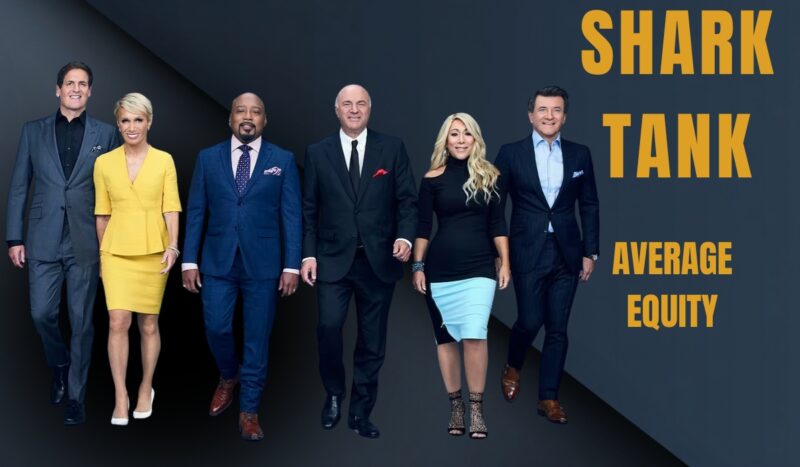
Concrete answer first: Most entrepreneurs on Shark Tank end up giving roughly 20% to 30% equity on average, even if they initially offer far less.
Across multiple datasets and seasons, the average equity stake closed on-air is about 24–27% per deal, with average investment sizes around $280K–$300K.
That means founders frequently give up about a quarter of their company in exchange for capital, exposure, expertise, and strategic connections. However, the exact equity depends heavily on revenue, growth stage, valuation credibility, and negotiation strength.
The Real Numbers Behind Shark Tank Deals

Understanding equity trends requires looking at multiple datasets because deal terms vary widely by season, industry, and founder leverage.
Average Shark Tank Deal Metrics
Metric
Typical Range
Research Average
Equity given up
15–40%
~24–27%
Investment amount
$100K–$500K
~$287K
Pre-money valuation
~$500K–$5M
~$1–2M common
Deal success rate (aired pitches)
~50–60%
~60% historically
These figures come from aggregated analyses of multiple seasons and deal databases.
A key insight: founders typically offer about 13–17% initially, but often close deals closer to 25–30% after negotiation pressure.
This reflects investor risk perception rather than simple valuation math.
Why Sharks Ask for More Equity Than Traditional Investors

Shark Tank investors behave differently from venture capital firms. The show compresses months of due diligence into minutes, increasing perceived risk. Investors compensate by demanding larger ownership stakes.
Sharks are not just passive investors. They often provide:
This strategic value partly explains why founders accept higher dilution than in typical startup funding rounds.
Another factor is stage. Many Shark Tank businesses are early consumer products with limited revenue history. That makes valuation uncertain and pushes equity demands higher.
Equity Trends by Business Stage
Different business maturity levels produce very different equity outcomes.
Typical Equity Expectations by Stage
Business Stage
Revenue Status
Equity Often Required
Idea stage
Pre-revenue
30–50%
Early revenue
Under $500K/year
20–35%
Growing business
$1M+ revenue
10–25%
Established brand
Strong growth
5–15%
These patterns align with observed Shark Tank deals and broader angel investing norms.
Founders with proven traction consistently negotiate better terms. Demonstrated sales reduce perceived risk more than projections.
Valuation Math Simplified
View this post on Instagram
On Shark Tank, valuation usually follows a simple equation:
Company valuation = Investment amount ÷ Equity offered
Example:
Investors then challenge this valuation based on revenue, margins, scalability, and competition.
This simplified calculation drives most on-screen negotiations.
However, real-world venture funding often uses more complex models.
Why Some Founders Give Up Less Equity
The lowest equity deals usually share several characteristics.
Strong revenue history is the most powerful leverage factor. Companies already generating millions in annual sales can negotiate smaller equity stakes because the risk is lower.
Patents or proprietary technology also strengthen the negotiating position. Intellectual property creates defensibility.
Clear market traction, existing partnerships, and strong branding also reduce equity demands.
In rare cases, multiple Sharks compete, driving equity downward through bidding.
When Founders Give Up Large Stakes
High equity deals usually happen when uncertainty is high.
Common triggers include:
Some deals even exceed 40% ownership when founders need rescue capital or operational restructuring.
These situations reflect investor risk management rather than exploitation.
Shark Tank vs Real Venture Capital Equity
One important nuance is that Shark Tank equity stakes are often higher than typical venture capital deals.
Comparison With Traditional Startup Funding
Funding Type
Typical Equity
Angel investors
10–25%
Venture capital seed round
10–20%
Shark Tank average
~25%
Bootstrapped partnerships
Variable
This difference exists because TV investors prioritize speed, publicity value, and consumer-product risk profiles.
The Hidden Value Beyond Money
Equity decisions should not be viewed purely financially.
Many successful Shark Tank companies credit investor involvement for:
These benefits sometimes outweigh dilution concerns.
Exposure alone has boosted sales for some companies even without finalized deals.
What Founders Should Actually Give Up

There is no universal correct percentage. However, research suggests a practical guideline:
Strategic Equity Guidelines
Situation
Suggested Range
Early product validation
20–35%
Proven sales
10–25%
Strong growth trajectory
5–15%
Strategic investor only
Negotiable
The key factor is not the percentage itself but whether the investor accelerates growth enough to offset dilution.
A smaller share of a much larger company can be more valuable.
Key Mistakes Founders Make
Many entrepreneurs misjudge valuation expectations. Overinflated valuations often result in rejected deals or heavier equity demands later.
Another common mistake is focusing only on cash rather than strategic partnership value.
Founders also sometimes underestimate operational scaling challenges, which investors factor heavily into negotiations.
Preparation, realistic projections, and market validation consistently improve outcomes.
Bottom Line
@daviefogarty These are the businesses I’m looking to invest in on Shark Tank #daviefogarty #sharktank #realitytvshows #sharktankau #business ♬ original sound – Davie Fogarty
The average Shark Tank deal typically involves giving up about one quarter of the company in exchange for roughly $300K investment plus strategic support.
Equity outcomes vary widely based on revenue, risk, negotiation leverage, and investor interest.
The smartest founders evaluate equity not just as ownership loss but as a trade-off for accelerated growth, expertise, and access to networks that can significantly increase company value.

Viola Moorhouse is the coauthor and research lead at Sharkalytics.com, specializing in startup performance tracking and investor strategy.
With a background in market research and business journalism, Viola focuses on separating the hype from the reality in the world of televised entrepreneurship. She’s passionate about making complex startup stories accessible to a wide audience.