
Meta may be preparing to turn part of its huge AI infrastructure buildout into a cloud business.
The idea is simple: if Meta owns or controls more AI computing capacity than it needs at a given moment, it could sell access to developers, startups and enterprises instead of letting expensive GPUs sit underused.
As of July 2026, the plan remains unconfirmed by Meta and was reported by Bloomberg, with Reuters reporting that plans could still change and that Meta declined to comment.
Even so, the story matters because Meta now expects 2026 capital expenditures of $125 billion to $145 billion, much of it tied to AI infrastructure. A cloud service could help convert that spending from a cost center into a new revenue line.
Why Meta Is Looking At AI Compute As A Business

Meta’s possible cloud move is best read as a financial response to the AI infrastructure race. The company is spending at a scale once associated mainly with Amazon Web Services, Microsoft Azure and Google Cloud, but its core business still depends heavily on advertising across Facebook, Instagram, WhatsApp, Messenger and Threads.
In 2025, Meta reported $200.97 billion in annual revenue and $72.22 billion in capital expenditures, including finance lease principal payments. By April 2026, management had raised its 2026 capex outlook to $125 billion to $145 billion, citing higher component pricing and added data center costs for future capacity.
A business selling AI compute would give investors a clearer answer to a recurring question: how does Meta earn money from AI infrastructure before AI assistants, smart glasses, agents and model APIs produce large direct revenue?
The cloud plan also fits a wider market pattern. Companies building generative AI tools need access to GPUs, model hosting, inference capacity and enterprise-grade APIs.
Demand is so high that Google reportedly limited Meta’s own Gemini model usage after Meta sought more capacity than Google could provide.
Reuters said the Financial Times report could not be independently verified, but the episode still showed how constrained AI compute supply had become in 2026.
What “Selling Extra AI Compute” Would Mean
Selling AI compute means renting access to the hardware and software needed to train or run AI models. For developers, the product could look like a menu: choose a model, send prompts or data through an API, pay based on usage, and avoid buying GPUs directly.
| Possible Meta Product | What Customers Would Buy | Likely Competitors | Why It Matters |
| Hosted Meta AI models | Access to models such as Muse Spark through APIs | Amazon Bedrock, Google Vertex AI, Azure AI | Higher-margin model access if developers want Meta’s models |
| Raw AI compute | GPU capacity for training, tuning or inference | CoreWeave, Nebius, Lambda, cloud GPU platforms | Faster revenue from infrastructure, even without a dominant model |
| Internal-plus-external capacity model | Meta uses most capacity internally and sells the rest | Hyperscalers and neoclouds | Could improve utilization during uneven demand cycles |
Amazon Bedrock offers a useful comparison because AWS describes it as a managed service that gives developers enterprise-grade access to foundation models from multiple AI companies.
Reuters reported that Meta’s planned service could resemble Bedrock by letting developers use AI models hosted on Meta infrastructure and pay for computing power.
Raw compute is different. Instead of paying mainly for a model API, a customer rents GPU capacity and brings its own training job, inference stack or custom model.
That market has grown quickly because AI labs and startups often need thousands of GPUs for short, intense periods rather than permanently owned infrastructure.
Why Data Center Utilization Matters
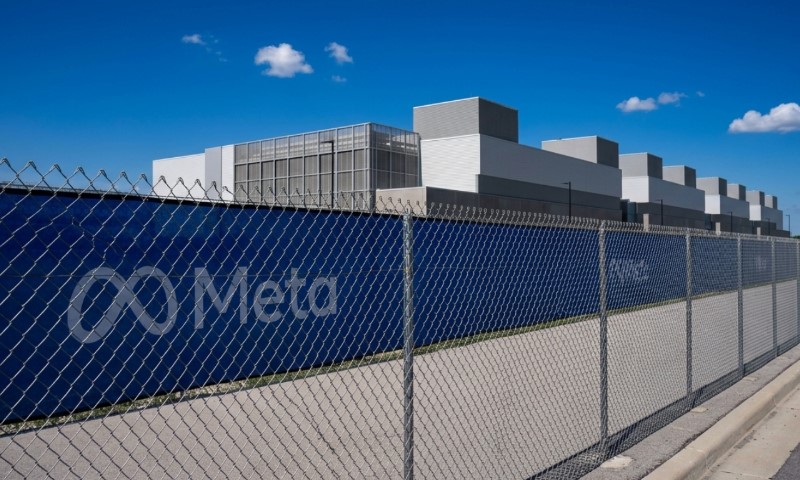
AI data centers are expensive before a single customer signs a contract. Meta must secure land, power, cooling systems, chips, networking gear, construction capacity and long-term energy arrangements. Once built, idle capacity becomes financially painful.
A cloud business could raise utilization. For example, Meta might need certain clusters for model training runs at one point in the year but have lower demand between major training cycles. Inference demand can also fluctuate across consumer apps, ads, business messaging and AI assistants. External customers could help fill gaps.
Meta is already securing outside capacity. Reuters reported on June 18, 2026, that Meta had new agreements with data center developer Crusoe, citing Bloomberg, including roughly 1.6 gigawatts of combined capacity across Childress, Texas, and Warrenton, Missouri. Reuters also noted that exact spending and delivery timing were not clear.
A gigawatt-scale AI buildout is not easy to hide inside ordinary corporate spending. It affects electricity planning, supply chains, depreciation, lease commitments and free cash flow.
For a company whose Family of Apps business throws off enormous operating income, AI infrastructure can still pressure margins if revenue does not arrive fast enough.
Why Investors Reacted So Strongly
The market reaction came because the cloud idea changed the narrative. Before the report, investors could view Meta’s AI capex mostly as spending required to improve ad targeting, build AI assistants, compete with OpenAI and Google, and support future wearables. After the report, part of that capex looked more like inventory for a possible infrastructure business.
Reuters reported that Meta shares rose more than 10% after the Bloomberg report, while CoreWeave and Nebius fell 10.8% and 12.4%, respectively, amid concern that Meta could become a competitor and reduce reliance on outside providers.
The reaction makes sense, but it also needs caution. Meta has not confirmed a launch date, pricing model, customer list or product name.
Reuters stated that plans were still in development and could change. Without those details, the market is pricing optionality rather than a proven cloud business.
How Meta Would Compare With AWS, Microsoft And Google
Meta would not enter a quiet market. It would face the strongest cloud operators in the world, each with years of enterprise relationships, compliance systems, billing infrastructure, support teams and global cloud regions.
| Company | Current Cloud Position In 2026 | Recent Reported Cloud Metric | Meta’s Gap |
| Amazon | AWS is the largest pure cloud franchise among Big Tech | AWS sales rose 28% year over year to $37.6 billion in Q1 2026 | Meta lacks a mature enterprise cloud stack |
| Microsoft | Azure sits inside a broader Microsoft Cloud platform | Microsoft Cloud revenue reached $54.5 billion in FY26 Q3 | Meta lacks deep enterprise software distribution |
| Alphabet | Google Cloud is growing quickly on AI demand | Google Cloud revenue grew 63%, with backlog over $460 billion in Q1 2026 | Meta has less cloud customer history |
| Meta | Consumer apps, ads, AI models, data centers | Capex guidance of $125 billion to $145 billion for 2026 | Product packaging and trust must be built |
Amazon, Microsoft and Alphabet can bundle AI compute with databases, storage, identity, security, analytics and productivity tools. Meta’s likely advantage would be more specific: access to Meta-controlled AI infrastructure, possible model APIs, and maybe competitive pricing if it has surplus capacity.
That means Meta does not need to become a full AWS clone to make the effort meaningful. A focused AI cloud could still attract startups, model developers, AI application companies and enterprises facing GPU shortages.
The Role Of Muse Spark And Meta’s AI Models
Model quality matters because hosted model access can produce better economics than bare GPU rental. If customers want a specific Meta model, Meta can charge for both the model and compute. If customers only want GPUs, price competition becomes tougher.
Meta introduced Muse Spark in April 2026 as the first model in a new series built by Meta Superintelligence Labs.
According to Meta’s announcement, Muse Spark powers the Meta AI app and website, would roll out across WhatsApp, Instagram, Facebook, Messenger and AI glasses, and would be offered in private preview through an API to select partners.
Reuters later reported that Muse Spark had not yet been released to developers and that a Wall Street Journal report said there was no scheduled launch date at that point. That matters because a Meta cloud business built around model APIs needs a model developers can actually test, trust and integrate.
A raw compute service could launch without a flagship model, but a model platform needs benchmarks, documentation, uptime guarantees, developer tooling, rate limits, safety policies and predictable pricing.
Why CoreWeave And Nebius Are Exposed

Neocloud providers built businesses around a simple market gap: hyperscalers had limited available GPU capacity, while AI companies needed more. CoreWeave became one of the most visible names in that category.
CoreWeave reported Q1 2026 revenue of $2.078 billion and revenue backlog of $99.4 billion. In its Q1 2026 earnings release, CoreWeave also said it had executed multiple new agreements with Meta, including a $21 billion commitment signed in March 2026.
That customer relationship explains why investors focused on CoreWeave after the Meta cloud report. If Meta becomes a seller of AI compute, it could reduce future purchases from neocloud partners, compete for the same customers, or both.
Still, the risk is not one-dimensional. A Meta cloud launch could also validate the size of the AI infrastructure market. If demand keeps growing faster than supply, CoreWeave and similar providers may still find buyers for capacity, especially where they offer specialized deployment, fast procurement or dedicated clusters.
The Business Case For Meta
Meta’s strongest argument is utilization. If the company is already building enormous AI infrastructure, then selling capacity during low-demand periods can improve returns without creating a fully separate business from scratch.
Potential benefits include:
- New revenue beyond advertising, especially from developers and enterprises.
- Better GPU utilization across training and inference cycles.
- Stronger developer ties for Meta AI models.
- More discipline around internal AI infrastructure costs.
- A hedge if consumer AI monetization takes longer than expected.
Meta also has a rare distribution advantage. Its AI products can be tested inside apps used by billions of people.
In December 2025, Meta reported 3.58 billion daily active people across its Family of Apps, up 7% year over year. That gives Meta a massive internal demand base before outside customers enter the picture.
The challenge is that internal demand may leave less spare capacity than the cloud story suggests. If Meta needs the hardware for AI agents, recommendations, ads, safety systems, business messaging, glasses and model training, a meaningful surplus may be occasional rather than constant.
The Main Risks
View this post on Instagram
A Meta AI cloud business would face several practical risks. The main question is not whether Meta can run large infrastructure. It already does. The harder question is whether it can package that infrastructure as a reliable, trusted external product.
Capacity May Not Be Truly Extra
Extra compute sounds easy, but AI infrastructure is often allocated months in advance. Training jobs, inference systems and product launches can consume capacity quickly. If Meta sells capacity externally and then needs it internally, it must choose between customer commitments and strategic AI development.
Enterprise Trust Takes Time
Cloud customers care about uptime, service-level agreements, compliance, data handling, support and billing transparency. Meta has immense infrastructure experience, but selling mission-critical cloud services to enterprises is different from running consumer apps.
Model Access May Be Late Or Limited
Muse Spark is central to Meta’s AI story, but outside developers need stable APIs and public documentation. A private preview is a start, not a market-scale platform.
Pricing Could Become Brutal
If Amazon, Microsoft, Google, CoreWeave, Nebius, Oracle and others all add AI capacity, prices may compress. Meta’s economics would depend on power costs, chip depreciation, utilization, networking efficiency and how much premium customers attach to Meta models.
Regulatory And Data Questions Could Slow Adoption
Some businesses may hesitate to place sensitive workloads on Meta infrastructure because Meta is so closely associated with advertising, social data and consumer platforms. Strong isolation, auditability and legal terms would be essential.
What To Watch Next
The key signals are concrete rather than promotional. A real cloud business should leave visible markers.
- A named Meta cloud or AI infrastructure product.
- Public API documentation for Muse Spark or successor models.
- Pricing for tokens, GPU hours or reserved capacity.
- Enterprise launch partners.
- Data center capacity disclosures tied to external sales.
- Commentary from CFO Susan Li on capex recovery or infrastructure revenue.
- Changes in Meta’s cloud spending with CoreWeave, Crusoe, Google or other partners.
- Segment reporting that separates AI infrastructure revenue from advertising.
If Meta adds only a small developer API, the move may be incremental. If it sells reserved GPU clusters to major AI labs and enterprises, it becomes a serious cloud infrastructure story.
A Cloud Pivot, But Not Yet A Cloud Business
Meta’s possible AI compute business is a rational response to enormous data center spending, but it is not yet a confirmed AWS-style cloud division.
The company has the balance sheet, infrastructure ambition and model roadmap to make the idea credible. It also has unresolved issues: no confirmed launch, unclear spare capacity, heavy internal AI needs and no long record as an enterprise cloud provider.
For 2026, the best reading is cautious: Meta may use excess AI capacity to create a new revenue stream, reduce investor anxiety over capex, and compete with neocloud providers.
A full cloud business would take more than spare GPUs. It would require developer trust, model access, reliable operations and pricing that survives a crowded AI infrastructure market.

Dave Mustaine is a business writer and startup analyst at Sharkalytics.com. His articles break down what happens after the cameras stop rolling, highlighting both big wins and behind-the-scenes challenges.
With a background in entrepreneurship and data analytics, Dave brings a sharp, practical lens to startup success and failure. When he’s not writing, he mentors founders and speaks at entrepreneur events.