
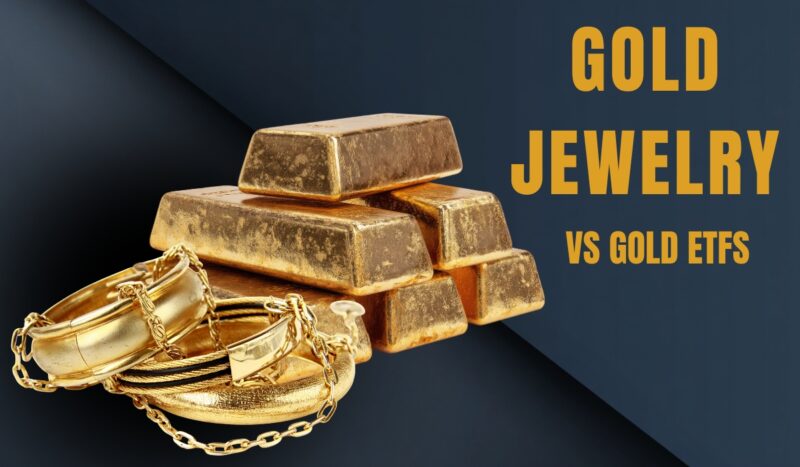
Gold occupies a central place in India’s financial and cultural habits, serving both emotional and investment purposes.
Investors often compare physical jewelry with Gold ETFs when seeking profitable outcomes.
Taking a closer look at acquisition costs, resale practices, liquidity, safety, and taxation reveals meaningful differences in long-term results.
Key Profitability Factors
Gold investments require attention to both visible and hidden costs.
Many buyers focus on market price alone, yet actual profit depends on a long chain of charges, deductions, liquidity features, and resale dynamics.
Cost Structure
Costs heavily influence final earnings, so a clear outline of the main components helps highlight where value is lost or saved.
Gold jewelry carries several financial layers that diminish eventual returns. Making charges often climb as high as 25% of metal value and never return during resale.
GST adds another 3% at the time of purchase, creating a higher base cost.
Storage and insurance generate ongoing expenses because jewelry requires safekeeping in lockers or secured home environments.
Gold ETFs operate on a far leaner model by avoiding craftsmanship fees and GST. Expense ratios usually fall between 0.4% and 1% per year.
Demat accounts add a minor recurring charge, yet the overall outflow remains minimal compared to physical jewelry.
Insights repeatedly show Gold ETFs as more cost-efficient due to the absence of fabrication costs and physical maintenance.
Liquidity
Liquidity determines how quickly an investor can convert holdings into cash without a heavy loss. Jewelry presents significant roadblocks.
Selling requires negotiating with jewelers who scrutinize purity, apply subjective pricing, and often pay below ready-market rates.
Timing also matters, as store availability, festival demand, and local market dynamics influence outcomes.
Gold ETFs create a smoother exit path. Investors gain immediate access to buyers through stock exchanges, enabling rapid sales during active trading hours.
Settlement normally deposits funds into a bank account within two business days.
Several platforms emphasize that this rapid exit capability supports emergency financial needs and offers convenience unavailable in physical markets.
Resale Value and Margins
Resale outcomes often determine long-term success, so a short comparison of value drivers helps clarify margin differences.
Items affecting jewelry resale include:
- Purity verification by the buyer
- Loss of making charges
- Impact of the craftsmanship category
- Influence of brand reputation
- Market demand at the time of sale
Gold jewelry rarely returns its full acquired value because fabrication costs vanish during resale.
However, certain gold accessories like female luxury gold watches offered at guld klocka dam can still offer timeless elegance and gifting value despite lower resale margins.
Buyers evaluate purity rigorously, and even minor deviations reduce payment.
Brand-related expectations also shift results, making margins inconsistent and often disappointing.
Gold ETFs closely track standard gold prices. Units represent high-purity benchmarks, giving investors returns aligned with current bullion values.
Minimal deductions at the sale result in stronger net gains compared to jewelry.
Tracking accuracy, lower slippage, and uniform valuation help ETFs produce more efficient margins.
Taxation
View this post on Instagram
Tax treatment affects both short-term and long-term profitability. India applies identical rules to gold jewelry and Gold ETFs.
Sales within 36 months fall under short-term capital gains and align with individual income slabs.
Holdings beyond 36 months incur long-term capital gains at 20 percent with indexation, which can lower effective tax.
Gold ETFs simplify compliance because all transactions occur through a demat account.
Investors receive clear documentation that supports record keeping, reduces filing errors, and assists with audits or formal financial reporting.
Risk and Safety Comparison
Gold investments differ sharply in exposure to physical and operational threats.
Physical gold must be protected, insured, and stored with constant attention, while digital gold operates inside a secure financial framework.
Gold jewelry brings ongoing vulnerability that can never be fully eliminated. Theft, accidental damage, and misplacement create continuous risk.
Owners often rely on bank lockers and insured storage options, yet those measures introduce recurring payments and logistical effort. Any lapse in care can result in permanent loss, as stolen or damaged jewelry may not be fully recovered through insurance.
Emotional attachment can also influence decisions, causing hesitation during emergencies.
Gold ETFs avoid those complications entirely. Units sit safely within electronic depositories overseen by regulated financial institutions.
No physical object exists that can be stolen or damaged, removing concern over environmental wear or burglary. Investors hold uninterrupted access through trading accounts and can monitor or liquidate positions anytime market hours permit.
Operational control remains stable without the need for safes, lockers, or insurance premiums.
Investment Flexibility and Accessibility

Investment style often shapes the long-term outcome.
Jewelry purchases seldom support steady, scalable accumulation because each piece carries design-driven pricing and a higher initial cost. Small, recurring additions rarely align with jewelry buying habits.
Even investors intending to store wealth rather than wear pieces face irregular purchase cycles and large cash requirements.
Those seeking clarity can look at the common barriers that limit jewelry as an investment choice:
- Larger upfront commitment due to design additions
- Limited suitability for recurring or systematic investing
- Inconsistent pricing tied to craftsmanship instead of pure metal value
- Reduced frequency of buying caused by the high expenditure each time
Gold ETFs solve these limitations with ease. A single unit priced near one gram allows beginners or budget-focused investors to enter gold markets without strain.
Digital platforms support structured, SIP-style accumulation, enabling consistent monthly growth that follows personal financial planning.
Fractional options add another layer of flexibility, letting users match contributions precisely to their budgets.
Such features make ETFs well-suited for long-term strategies that rely on gradual, disciplined expansion rather than infrequent large purchases.
Which Offers a Higher Profit Margin?
@financialtimes As gold reaches record highs, the FT’s Katie Martin and Rob Armstrong look at the demand for the precious metal and what it takes to move the asset around the world. Tap the link in our bio to listen to the full episode. #gold #markets #investing #financialtimes #ft ♬ original sound – FinancialTimes
Gold ETFs commonly create stronger resale margins due to low acquisition costs, reduced ongoing charges, digital liquidity, and exit prices that mirror market rates. Investors retain more value, spend less on fees, and face fewer obstacles when converting holdings into cash.
Gold jewelry often struggles to match ETF outcomes. High non-recoverable making charges, subjective purity tests, and manual resale processes compress returns. Emotional attachment can delay liquidation as well, reducing efficiency for wealth building.
Gold ETFs therefore, serve financial goals more effectively, while jewelry continues to play a cultural and gifting role rather than a profit-centered investment strategy.

Dave Mustaine is a business writer and startup analyst at Sharkalytics.com. His articles break down what happens after the cameras stop rolling, highlighting both big wins and behind-the-scenes challenges.
With a background in entrepreneurship and data analytics, Dave brings a sharp, practical lens to startup success and failure. When he’s not writing, he mentors founders and speaks at entrepreneur events.