
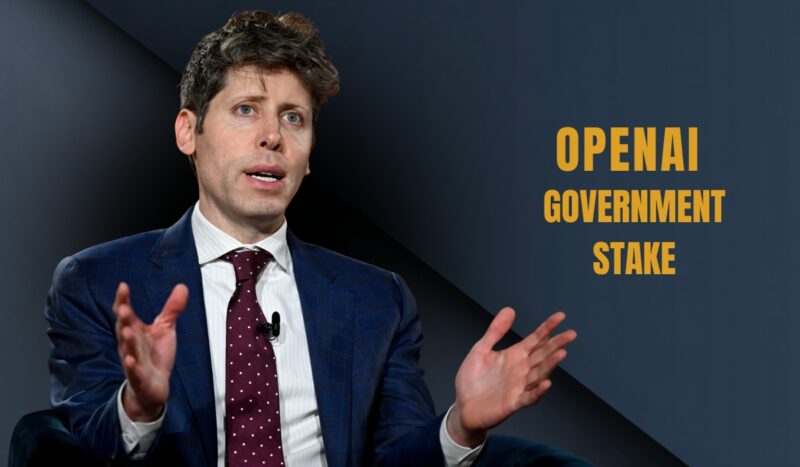
OpenAI has reportedly discussed giving the US government a 5% equity stake in the company, according to the Financial Times. No agreement has been announced, and Reuters said it could not independently verify the report. OpenAI and the White House had not publicly confirmed the talks when Reuters sought comment.
A deal would put part of one of America’s most valuable private technology companies into public hands. At the reported $852 billion valuation cited in coverage, 5% would represent about $42.6 billion on paper.
The stake could help seed a public wealth fund, giving citizens indirect exposure to AI-driven growth. Yet the percentage leaves major questions unanswered, including voting rights, valuation, dilution, regulatory conflicts, and how any returns would reach the public.
What Is OpenAI Reportedly Proposing?
View this post on Instagram
The reported idea involves allocating 5% of OpenAI’s equity to a government-linked vehicle, potentially modeled on the Alaska Permanent Fund.
OpenAI has also raised the possibility that other leading US AI developers could contribute comparable stakes, although no rival has publicly agreed, according to a Reuters report.
OpenAI’s official industrial-policy paper already calls for a Public Wealth Fund that would invest in AI companies and businesses adopting AI. Returns could be distributed to citizens, including people who do not own stocks or retirement accounts.
| Element | Current Status | Why It Matters |
| 5% OpenAI stake | Reported discussion, no completed deal | Could create a major public asset before an IPO |
| Stakes from rivals | Reported OpenAI proposal | A broader pool would reduce reliance on one company |
| Public Wealth Fund | Published OpenAI policy idea | Offers a route from equity to citizen benefits |
| Voting or board rights | Not disclosed | Determines whether ownership also means influence |
| Direct public payments | Concept only | Requires distribution rules |
Public reporting has not explained whether Washington would receive donated shares, buy stock, exchange federal support for equity or hold the interest through a new fund. Each route has different legal and governance consequences.
Why Would OpenAI Offer the Government Equity?
OpenAI has several possible incentives, even if the reported plan never becomes a signed transaction.
Public Legitimacy Has Become a Business Issue
AI companies are attracting enormous capital while many Americans remain worried about employment, electricity demand, and who receives the financial gains. A June 2026 Reuters/Ipsos poll found that 53% of US adults feared AI could cost them or someone in their household a job.
A public stake gives OpenAI a concrete answer to a difficult question: how can ordinary citizens share in AI wealth without buying private-company shares? A fund could hold equity for decades and distribute dividends, finance public programs, or do both.
Government Relations Matter Before an IPO
OpenAI and Anthropic both confidentially filed for US initial public offerings in June 2026, according to Reuters reporting. OpenAI was reportedly targeting a valuation of up to $1 trillion.
Greater government involvement in advanced models and strategic technology also means that regulatory uncertainty can affect product launches and investor confidence.
Government ownership could align financial interests. Washington would benefit if OpenAI’s value rose, while OpenAI might gain a steadier political relationship.
The arrangement could also produce a serious conflict. The same government may become shareholder, regulator, customer, and national-security authority. Officials could face pressure to protect the value of a public investment while deciding whether to impose costly restrictions on the company.
OpenAI Already Has Public-Interest Governance
OpenAI Group became a public benefit corporation in October 2025. The OpenAI Foundation controls the commercial group, appoints its directors, and holds a 26% equity stake. OpenAI says its corporate structure connects commercial growth with the organization’s stated mission.
A government stake would add another form of public-interest ownership, but it would not automatically change control. The Foundation’s special governance rights would remain decisive unless a separate agreement granted Washington board seats, vetoes, or other powers.
How Would Government Ownership Differ From Normal AI Policy?
Equity is neither a tax nor a regulation. It gives the holder a financial claim on future value, while ordinary policy tools impose rules, collect revenue, or fund projects.
| Policy Tool | Public Side Receives | Company Side Gives | Main Trade-Off |
| Regulation | Safety and compliance protections | Operational limits and reporting | No direct share of gains |
| Corporate tax | Budget revenue | Cash based on taxable income | Receipts depend on profits and tax rules |
| Subsidy or grant | Jobs, facilities or research capacity | Investment commitments | Taxpayers may receive no financial upside |
| Grant-for-equity deal | Shares in exchange for support | Ownership and dilution | Government becomes investor and policymaker |
| Public wealth fund | Long-term assets and possible dividends | Stock, cash, or both | Requires strong governance and diversification |
Reuters has identified several routes for public participation in AI wealth, including stock-based taxes, federal funding exchanged for equity, and government representatives in corporate governance.
Senator Bernie Sanders has proposed a far more aggressive model involving a one-time 50% stock-based tax on major AI companies.
A voluntary 5% allocation would be unusual because it appears to originate with the company rather than from a rescue package, tax requirement or conventional grant negotiation.
Has Washington Taken Corporate Stakes Before?
The federal government’s 2025 Intel agreement offers a useful comparison. Intel said Washington would purchase 433.3 million shares for $8.9 billion, equal to a 9.9% stake. Funding came from previously awarded CHIPS Act and Secure Enclave grants.
Intel described the holding as passive. The government received no board seat, special information rights, or broad governance authority. Washington also agreed to vote with Intel’s board on most shareholder matters. The arrangement shows how a large public stake can provide financial exposure without day-to-day control.
OpenAI would present a different case. Intel’s deal was linked to domestic semiconductor manufacturing and supply-chain security. OpenAI’s value rests heavily on models, software, computing infrastructure, intellectual property, and expected future revenue.
An OpenAI holding could therefore raise sharper questions about federal procurement, access to advanced models, national-security restrictions, and whether policy decisions were benefiting a company partly owned by the government.
What Would a 5% Stake Actually Give the Government?
OpenAI has discussed giving the US government a 5% stake, according to reports, as AI firms face growing scrutiny in Washington over the potential misuse of advanced models and whether Americans will share in the sector’s profits pic.twitter.com/1OX8PXArMz
— Reuters (@Reuters) July 2, 2026
Five percent ownership would provide economic value, but control would depend on the share class and accompanying contract.
A passive holding could entitle a public fund to proceeds from dividends, share sales, or an acquisition. Voting shares might allow participation in shareholder decisions. A board seat or veto right would create far greater influence, even without majority ownership.
Dilution also matters. New fundraising rounds or employee stock grants could reduce a 5% holding unless Washington received rights to maintain its percentage. Transfer restrictions or an IPO lockup could delay any public return.
OpenAI’s Foundation-controlled structure means a standard 5% equity block would fall well short of operational control. The OpenAI Foundation currently appoints the Group’s board and can replace directors, powers far more significant than ordinary minority-shareholder rights.
Arguments For and Against the Proposal
Supporters can argue that public ownership would let taxpayers participate in a sector supported by public research, government contracts, electrical infrastructure, and decades of federally funded computing science.
A diversified wealth fund could spread gains beyond households already invested in private companies, public stocks, or retirement accounts. It could also create a long-term national asset rather than relying solely on annual corporate-tax receipts.
Critics would focus on conflicts and favoritism. A regulator with a valuable stake may hesitate to impose safety rules that could lower the company’s valuation. Competitors could argue that OpenAI received privileged access, favorable procurement terms, or softer oversight.
International consequences are also possible. A Forrester analyst told Reuters that other jurisdictions might demand comparable arrangements as a condition of market access. Enterprise customers outside the US could reconsider assumptions about neutrality and data sovereignty when buying services from a company partly owned by Washington.
Investment risk belongs in the debate as well. Private-company valuations can fall, IPO prices can disappoint, and technology leadership can shift quickly. A concentrated holding in one AI developer would expose the public to company-specific losses.
Independent management, transparent reporting, diversification, and clear restrictions on political interference would be essential for any credible public wealth fund.
What Needs to Happen Before Any Deal Becomes Real?
Depending on the chosen structure, Congress may need to authorize a new fund, stock-based tax, spending mechanism or governance framework. A private agreement alone would not explain how proceeds become a durable benefit for citizens. Publicly discussed legal routes range from equity exchanged for government funding to taxes payable in company stock. OpenAI’s reported 5% proposal is an early political and financial concept, not a completed transfer. The idea blends corporate equity, industrial policy, and wealth distribution in a form rarely associated with a leading software company. A passive stake held through an independently managed public fund could give citizens exposure to AI growth without handing Washington control of OpenAI. A deal tied to regulatory favors, opaque voting rights, or preferential treatment would create serious credibility problems. The decisive issue is not the percentage by itself. Ownership terms, fund governance, regulatory safeguards, and distribution rules would determine whether the arrangement becomes a meaningful public asset or an unusually close alliance between government and one dominant AI company. Dave Mustaine is a business writer and startup analyst at Sharkalytics.com. His articles break down what happens after the cameras stop rolling, highlighting both big wins and behind-the-scenes challenges. With a background in entrepreneurship and data analytics, Dave brings a sharp, practical lens to startup success and failure. When he’s not writing, he mentors founders and speaks at entrepreneur events.
The Bottom Line